B3’s response to the extreme volatility helped maintain orderly trading during what could have been a chaotic session. But it also exposed a shortcoming in the market’s safeguards: participants only learnt about important changes to trading rules on the very day they needed to rely on them.
Brazil now has an opportunity to turn the lessons of that session into lasting improvements. As the country prepares to welcome a second derivatives exchange, decisions about when trading stops and restarts will need to be coordinated across venues, not just within one exchange. The task for Brazil now is to turn a successful intervention under pressure into a clear, predictable framework that participants can rely on before the next shock arrives.
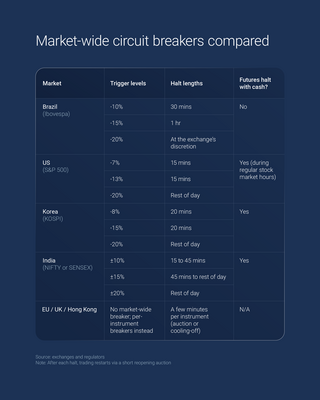
Exchanges use circuit breakers to give market participants time to reassess prices and rebuild liquidity in moments of extreme volatility. Under B3’s rules, a 10% fall in the Ibovespa stock index from the previous day’s close halts trading in stocks and options for 30 minutes. A decline of 15% triggers a further one-hour halt, while a 20% fall brings a suspension whose duration is at B3’s discretion.
Futures and individual stocks have their own safeguards. Individual stocks also have price bands, which send stocks into auction if they experience large price moves, while futures trade within daily price limits instead of being halted by circuit breakers. These safeguards are distinct, but they operate in interconnected markets, so their effects on trading must all be considered together.
What happened on 26 October
On the morning of 26 October, B3 made an ad hoc change to how the second Ibovespa circuit-breaker threshold would be set. The index move that was indicated in the opening auction would now determine the level: a decline between 10% and 15% would leave the next threshold at 15%, while a decline between 15% and 20% would put it at 20%. The aim was to avoid restarting the market only to halt it again immediately.
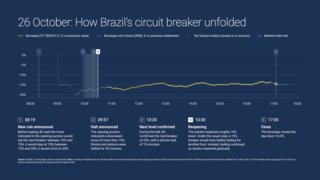
In the opening auction, the indicated fall exceeded 10%, and B3 halted trading in stocks and options for 30 minutes.
Just before the end of the halt, with the index indicated roughly 16% lower, B3 confirmed that, under the morning's rule, the next circuit breaker would be set at 20%. It also specified that this halt, if triggered, would last 15 minutes.
When the market reopened, the index was roughly 16% lower. Under the usual rules, this would have triggered another one-hour halt. Instead, trading continued, and the Ibovespa closed the day down 14.3%.
B3’s adjustment avoided another hour in which investors would have been unable to transfer risk through stocks, options or the Ibovespa Index ETF. Futures, meanwhile, continued pricing the news.
Our recommendations
B3 deserves credit for maintaining orderly trading under exceptional pressure that day. Even so, there are lessons to be learned. Our recommendations aim to build on that success through clearer rules, advance planning and closer coordination across different markets.
1. Give the market room to trade after reopening
B3’s adjustment avoided an immediate second halt, but the rule still left room for consecutive suspensions. Had the opening auction indicated a decline between 10% and 15%, the next threshold would have still been set at 15%. A reopening just short of that threshold could then have been followed by another halt after only a small additional fall.
A more consistent framework would give the market a defined amount of room to trade after reopening. One option could be to measure the next circuit-breaker threshold from the reopening level rather than the previous day’s close.
The objective is to avoid a situation where a reopening leads straight into another suspension, unnecessarily prolonging the period in which participants can't trade or transfer risk.
2. Make the trigger methodology clear
B3 made clear the initial circuit breaker would be triggered by the index level indicated in the opening auction, rather than by traded prices. In stressed markets, however, indicative prices can sit far from the levels at which trading eventually begins. An outlying indication could trigger an unnecessary halt; allowing the auction to complete at an unfair price has its own risks.
The framework should explain how the indicative index level is calculated, how it is assessed against the threshold and what role exchange discretion plays. Participants should have enough information to understand how a decline is measured before trading begins.
3. Publish event-day arrangements in advance
While the election result was a surprise, the date of the election wasn’t. B3 had already widened price bands for index stocks from late September. Yet important circuit-breaker details—including how the next threshold would be set and the duration of a halt at 20%—were only communicated on the morning of 26 October.
For scheduled events with the potential to produce exceptional volatility, B3 should publish a scenario plan in advance. This should explain how circuit breakers, reopening arrangements and price bands will operate under different market conditions. To help preserve market stability, price bands across all stocks and ETFs should also be set wide enough before trading starts to account for large price moves that are typically seen at the market open.
Flexibility is still desirable to have in the event something genuinely unforeseen happens. But planning would reduce uncertainty about decisions that can be made beforehand, allowing participants to concentrate on pricing, managing risk and providing liquidity.
4. Coordinate safeguards across products and venues
Index futures continued trading throughout the cash-market halt, subject to their daily price limits. B3 widened those limits in stages, from 10% to 15% to 20%, as it had signaled it would do the preceding Friday. Even so, before the cash market opened, the index future was stuck at its 15% floor for almost half an hour before the 20% limit took effect.
When cash trading is halted and futures are constrained by a price limit, participants’ ability to transfer risk can be restricted in both markets. The controls therefore need to be designed together. Otherwise, prices in related markets can move out of line, disrupting price discovery.
B3 aligned the thresholds on the day, placing both the futures floor and the next cash-market circuit breaker at 20%, but ideally that coordination should be done in advance.
This is not a uniquely Brazilian problem. Our 2020 paper on market-wide circuit breakers examined a similar issue in the US, where futures were constrained by their overnight price limit while the S&P 500 ETF continued trading lower. The episode illustrates why safeguards that appear reasonable in one market can create problems when considered alongside another.
The prospect of a second derivatives exchange in Brazil adds another dimension to this discussion. Where venues offer overlapping or closely correlated products, a last-minute rule change on one venue could create a mismatch with another.
Brazil should establish a common approach before that becomes a live problem, including clarity about who coordinates decisions across venues. The US framework—common equity-market circuit-breaker rules across exchanges, with futures tied to cash-market triggers during regular trading hours—offers a starting point.
Preparing for the next shock
B3’s intervention allowed trading to continue through an exceptional market shock. The opportunity that the exchange has now is to make that outcome less dependent on decisions taken under pressure.
That means a reopening framework that avoids unnecessary consecutive halts, a transparent trigger methodology, event-day arrangements published in advance and safeguards coordinated across related markets and venues.
Exchange discretion must and will remain important, but ideally it should serve as a complement to a clear framework and not a substitute for one.